
ALAN TURING
15 panels 72p0 x 72p0 each arranged on a regular grid. 6 color max per panel
The work of Alan Turing encompassed mathematics, logic, electromechanical and stored-program computing, engineering, cryptology and enciphering, artificial intelligence, the mathematical nature of biology and how reaction-diffusion equations can be used to describe pattern forming. He's a war hero and a convicted felon. He loved Snow White and died in 1954 under mysterious circumstances. This is a one of a kind and hand-printed artist proof. The technique uses laserprint plates in a process using similar chemistry as stone lithography.
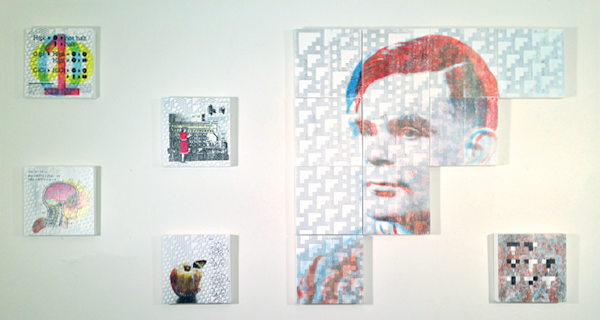
All fifteen panels fininished. Maximum of 6 colors per panel (silver, white, process yellow, process magenta, process, cyan, process black, custom red and custom blue).

There are 15 72p0 x 72p0 panels arranged on a regular grid. The first plate for each panel is metallic silver (seen here printed on the first five panels).

The first ten panels with one color.

The second color on eight panels (white and custom red).
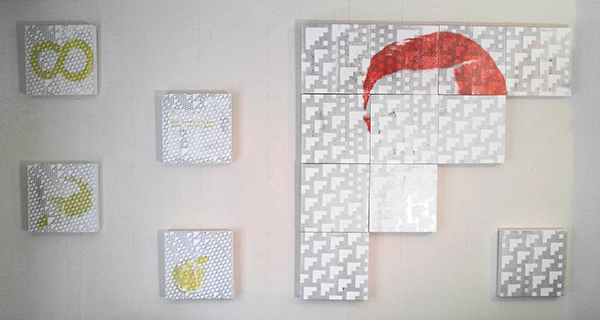
Process yellow added to four panels.

The final six panels of red printed and process magenta printed on four panels. Still to print process cyan and process black.

The last color on the last panel.
Want to see more? Come see the unveiling of the finished piece: goo.gl/PSj9L


